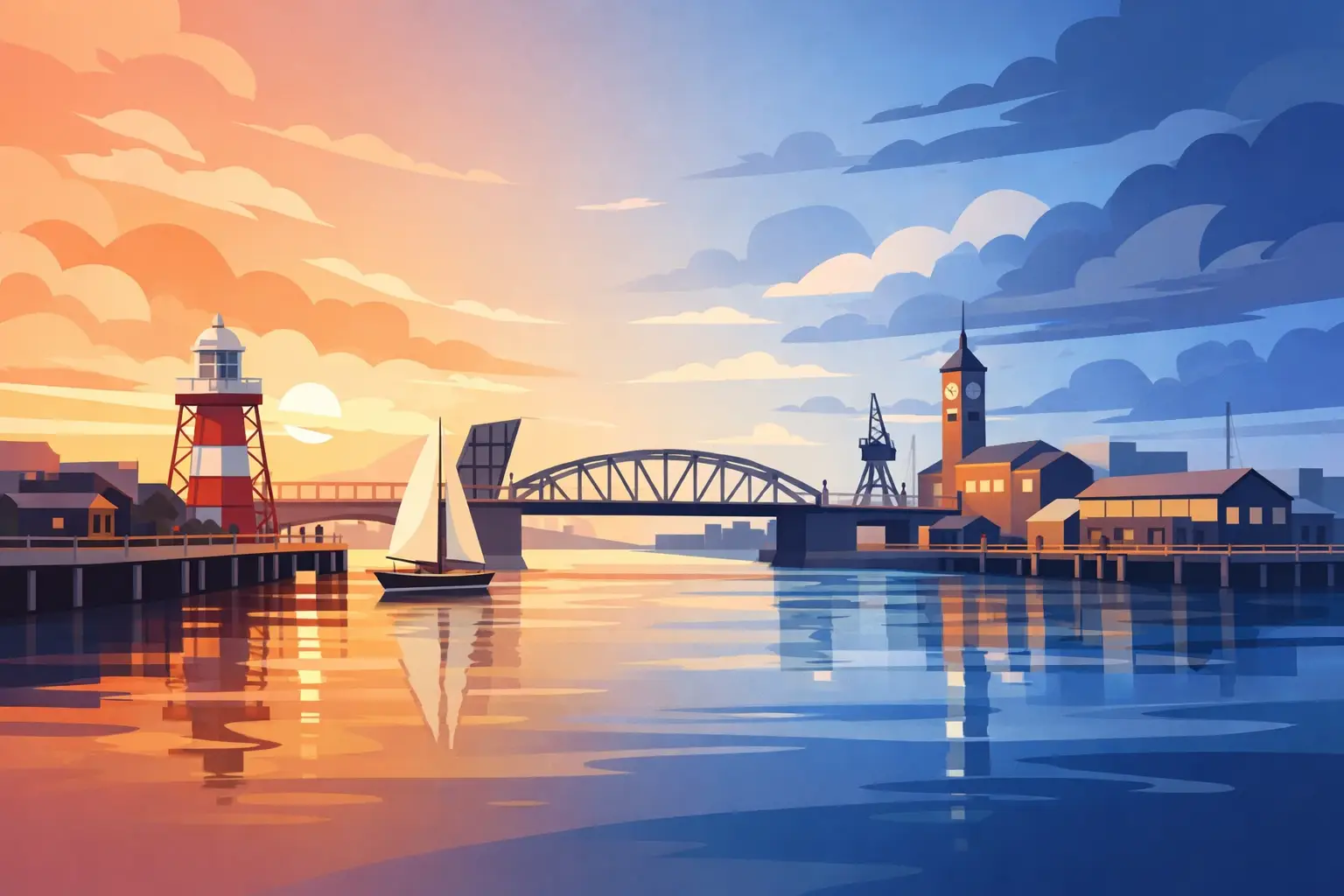
The harbour does not offer a fixed view. A Port Adelaide harbour painting has to make room for that fact: for the green-grey water lifting against timber piles, the hard geometry of sheds and cranes, and a strip of late sun briefly warming a warehouse wall. It is a working place before it is a picturesque one. Its beauty comes with salt, weather, rust, tide and the long pause between movements on the water.
For a painter who has lived beside it, Port Adelaide is not simply a collection of recognisable landmarks. It is a place felt in the body. The smell of the river when the wind turns. The low call of vessels in fog. The wide sky gathering over roofs and masts. These are the quieter truths that give a harbour scene its weight.
A Harbour Made by Work and Water
Port Adelaide carries its history close to the surface. Wharves, ships, railway lines, old brick buildings and industrial silhouettes sit alongside the river’s shifting light. Nothing here needs embellishing. The harbour already holds a tension between labour and stillness that a painting can bring forward.
That tension matters. A polished coastal scene may offer blue water and a clean horizon, but this harbour asks for a different kind of attention. Its water can be muddy, metallic or unexpectedly luminous. A bank of cloud can turn the whole river silver. In the late afternoon, a weathered hull or corrugated wall may catch an amber glow that lasts only minutes.
Painting it well means resisting the urge to tidy it up. The dark areas are part of the subject. So are the gaps between buildings, the piled timber, the distant machinery and the softened edges of a rain-filled sky. They give the light somewhere to land.
Why a Port Adelaide Harbour Painting Feels Personal
The strongest harbour paintings are not made from a passing glance. They come from return visits and accumulated memory. The view changes, yet certain rhythms remain: the tide pressing along the river, gulls cutting across the open sky, the silhouette of a vessel held against cloud.
For Roger Alby Richter, that sense of familiarity is inseparable from lived experience. Years of Navy service, oil-rig work and outdoor labour have left an understanding of working water that cannot be borrowed from a photograph. A ship is not merely a shape on the horizon. It has mass, purpose and a presence that changes the surrounding air.
This does not make the paintings documentary records. Oil paint allows room for feeling. A sky may become more spacious than the literal scene, and reflections may dissolve into broken strokes of slate, ochre and pale blue. The aim is not to inventory every bollard or window. It is to hold the mood of a particular hour, when the harbour seems to draw breath.
That distinction is often what collectors respond to. They may have a personal connection to Adelaide, a memory of travelling through the Port, or simply an affinity for maritime places that feel weathered and real. The painting gives them more than a location. It gives them an atmosphere they can return to.
Light Is the Real Subject
Harbour light is rarely simple. It reflects upward from the water while cloud filters it from above. It catches on painted steel, wet pilings and the edge of a passing boat, then disappears into the deep shadow beneath a wharf. In oil, these changes can be built slowly, layer over layer, until the surface carries something of the harbour’s physical air.
A muted palette often says more than bright colour. Greys are never only grey: they may carry violet, blue, green or warm earth beneath them. A brown river can hold flashes of copper. A nearly black hull can become the richest part of the canvas when it sits beside a thin band of cool light.
There is a trade-off in every decision. Too much detail can make the scene feel illustrated and static. Too little can lose the character of the place. The work lies in choosing what the eye needs: a mooring line, a hard roofline, the suggestion of distant cranes, a reflection broken by the current. The rest can remain open, allowing the viewer to feel their way into the painting.
Living With a Harbour Scene
An original harbour work changes a room without demanding it become nautical. Its industrial textures and restrained colour sit naturally in contemporary interiors, older homes and spaces with timber, linen, stone or aged metal. It can bring depth to a quiet study, a dining room or an entry where the light changes through the day.
Scale matters, but not in the usual simple way. A small painting can hold a concentrated, private mood – almost like looking through a window at a remembered place. A larger work gives the sky and water space to gather around the viewer. Neither is inherently better. The right choice depends on the wall, the room and whether you want a moment of intimacy or a stronger visual anchor.
It is also worth giving a harbour painting room to be seen. Avoid hanging it where competing frames, busy shelves or direct glare flatten its subtleties. Gentle, indirect light lets the oil surface show its changes, especially where thin passages of paint meet heavier, textured marks. As morning fades into afternoon, the work may reveal different tones of its own.
The Value of an Original View
A reproduction can supply an image, but an original painting retains the decisions made by hand. The brushwork is there. So are the adjustments, the scraped-back passages, the colours that shifted as the painting found its balance. No two are alike because no two encounters with the harbour are alike.
This is especially meaningful for buyers building a home around objects with a genuine story. An original oil painting does not need to match everything around it. Its task is more lasting: to create a point of stillness, to hold a place that matters, and to offer more each time it is looked at.
At Richter Art, harbour works sit alongside landscapes, storm skies and coastal scenes, but Port Adelaide has its own gravity. It joins the personal and the industrial, the local and the enduring. The river has carried working boats, departures, weather and memory for generations. A painting can only take one small portion of that life, but if it catches the right light, that portion is enough.
When choosing a harbour painting, look beyond whether it matches a colour scheme or names a familiar place. Notice where your eye rests. It may be in the quiet water beneath a wharf, the glow on a distant wall, or the broad weather moving in from the west. That is often where the painting has begun to belong to you.
Leave a Reply